UK Law Commission: Options Paper includes criminal offence of failure to prevent human rights abuses
Web cookies (also called HTTP cookies, browser cookies, or simply cookies) are small pieces of data that websites store on your device (computer, phone, etc.) through your web browser. They are used to remember information about you and your interactions with the site.
Session Management:
Keeping you logged in
Remembering items in a shopping cart
Saving language or theme preferences
Personalization:
Tailoring content or ads based on your previous activity
Tracking & Analytics:
Monitoring browsing behavior for analytics or marketing purposes
Session Cookies:
Temporary; deleted when you close your browser
Used for things like keeping you logged in during a single session
Persistent Cookies:
Stored on your device until they expire or are manually deleted
Used for remembering login credentials, settings, etc.
First-Party Cookies:
Set by the website you're visiting directly
Third-Party Cookies:
Set by other domains (usually advertisers) embedded in the website
Commonly used for tracking across multiple sites
Authentication cookies are a special type of web cookie used to identify and verify a user after they log in to a website or web application.
Once you log in to a site, the server creates an authentication cookie and sends it to your browser. This cookie:
Proves to the website that you're logged in
Prevents you from having to log in again on every page you visit
Can persist across sessions if you select "Remember me"
Typically, it contains:
A unique session ID (not your actual password)
Optional metadata (e.g., expiration time, security flags)
Analytics cookies are cookies used to collect data about how visitors interact with a website. Their primary purpose is to help website owners understand and improve user experience by analyzing things like:
How users navigate the site
Which pages are most/least visited
How long users stay on each page
What device, browser, or location the user is from
Some examples of data analytics cookies may collect:
Page views and time spent on pages
Click paths (how users move from page to page)
Bounce rate (users who leave without interacting)
User demographics (location, language, device)
Referring websites (how users arrived at the site)
Here’s how you can disable cookies in common browsers:
Open Chrome and click the three vertical dots in the top-right corner.
Go to Settings > Privacy and security > Cookies and other site data.
Choose your preferred option:
Block all cookies (not recommended, can break most websites).
Block third-party cookies (can block ads and tracking cookies).
Open Firefox and click the three horizontal lines in the top-right corner.
Go to Settings > Privacy & Security.
Under the Enhanced Tracking Protection section, choose Strict to block most cookies or Custom to manually choose which cookies to block.
Open Safari and click Safari in the top-left corner of the screen.
Go to Preferences > Privacy.
Check Block all cookies to stop all cookies, or select options to block third-party cookies.
Open Edge and click the three horizontal dots in the top-right corner.
Go to Settings > Privacy, search, and services > Cookies and site permissions.
Select your cookie settings from there, including blocking all cookies or blocking third-party cookies.
For Safari on iOS: Go to Settings > Safari > Privacy & Security > Block All Cookies.
For Chrome on Android: Open the app, tap the three dots, go to Settings > Privacy and security > Cookies.
Disabling cookies can make your online experience more difficult. Some websites may not load properly, or you may be logged out frequently. Also, certain features may not work as expected.
Monday, April 25, 2022
2:00pm - 3:15pm
Hybrid Event
Dodd Center for Human Rights - Room 162 & Zoom
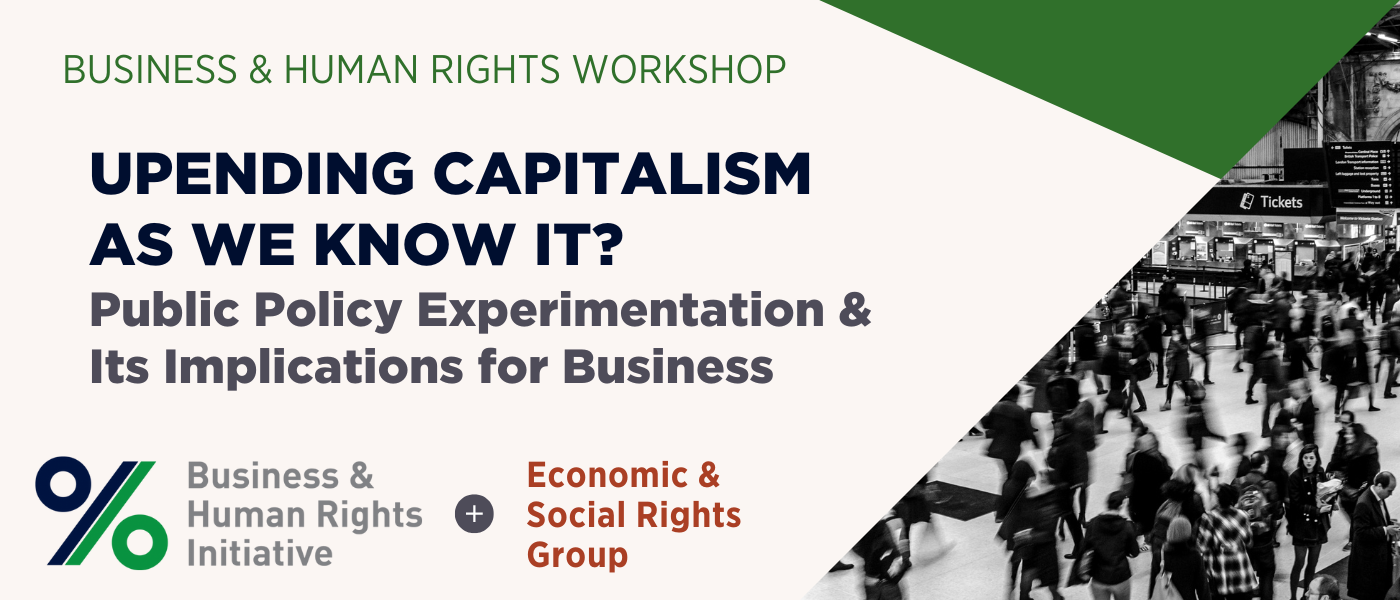
About This Workshop:
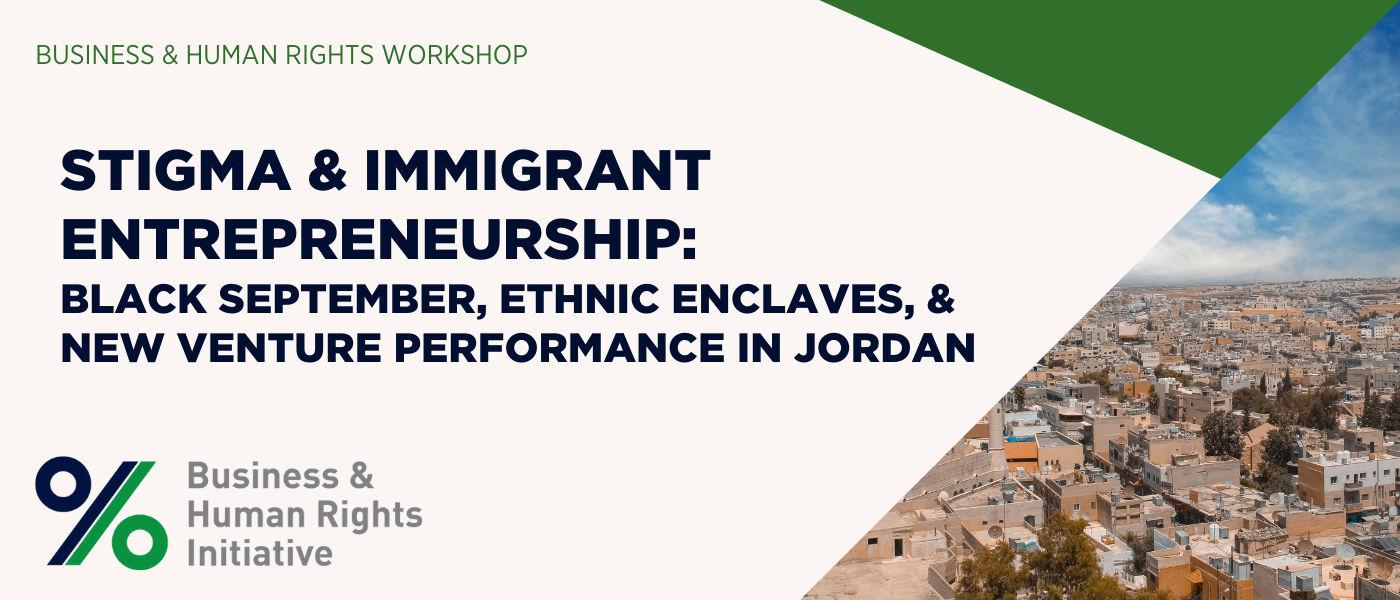
The Business and Human Rights Workshop is dedicated to the development and discussion of works-in-progress and other non-published academic research. Below find the abstract for a preview of the paper. Please register for a link to read Prof. Ryan Cole's paper, the focus of this workshop.
Prior research on immigrant entrepreneurship has largely overlooked the difficulties faced by stigmatized immigrant groups and the strategies that such immigrant groups can undertake to improve new venture performance. To address this issue, we examine immigrant entrepreneurship in Jordan. We find that stigmatized immigrant entrepreneurs in Jordan are more negatively affected by government practices than native and non-stigmatized immigrant entrepreneurs. Moreover, we find that stigmatized entrepreneurs can partially mitigate these effects by founding their ventures in established ethnic enclaves where entrepreneurs can access brokers with social ties that can help overcome discrimination. Empirically, we examine this phenomenon using data on new venture performance of 8756 entrepreneurs in the Hashemite Kingdom of Jordan from 2003 to 2013 and supplemented with 60 qualitative interviews.
Presenter:
Prof. Ryan Coles,
UConn School of Business
Discussant:
Prof. Michael Rubin,
UConn Human Rights Institute,
Schools of Engineering & Business
This workshop will be hosted both in-person and on Zoom. Please register regardless of the modality you wish to join. The workshop will not be recorded.
This event is sponsored by the Business and Human Rights Initiative, a partnership by Dodd Human Rights Impact, the UConn School of Business, & Human Rights Institute.
Thursday, April 21, 2022
12:30pm - 1:50pm
Virtual Event

Gary M. English,
Board of Trustees Distinguished Professor
UConn School of Fine Arts - Dramatic Arts
Robin Greeley, Associate Professor of Art History
Asif Majid, Assistant Professor, Dramatic Arts & Human Rights
Glenn Mitoma, Director, Dodd Impact
Sebastian Wogenstein, Associate Professor, German Studies
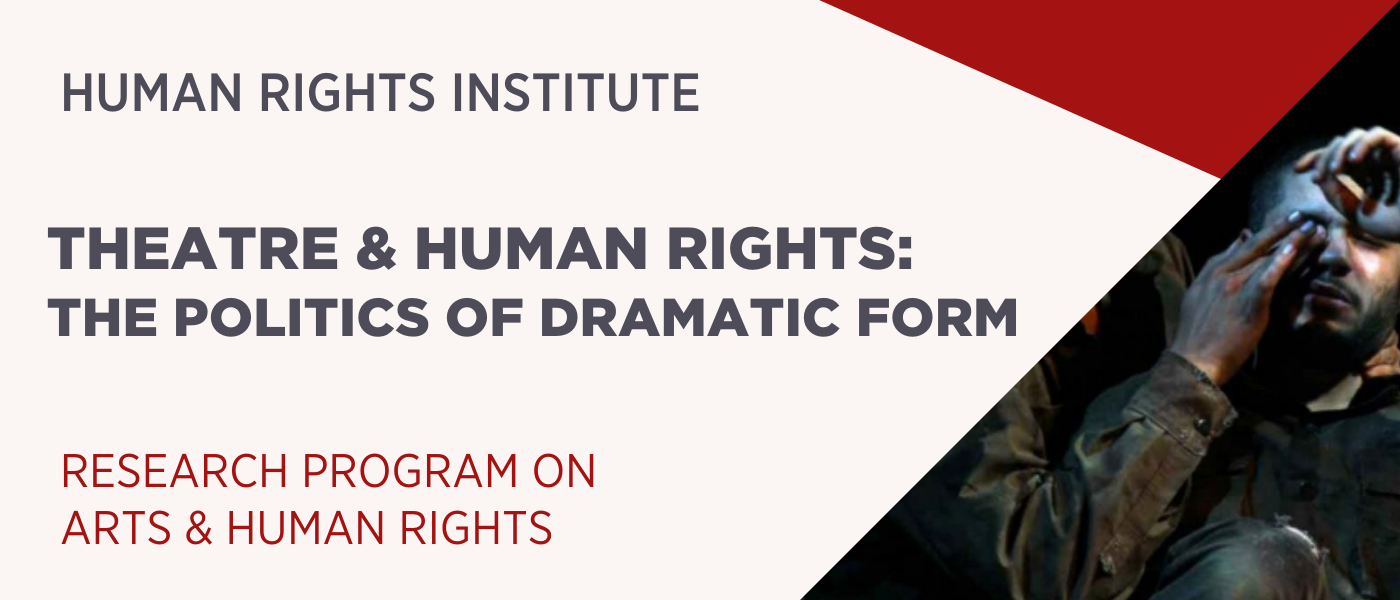
Join us for a presentation of research that develops a theoretical foundation and methodology for how theatre and human rights intersect, and demonstrates how various dramatic forms interrogate human rights questions from within the specific perspective of Theatre as a discipline. While human rights research and programming often employ the arts as "representations" of atrocities--abusive political, social and economic practices--this study focuses on the various types of dramatic form and structure as uniquely positioned to investigate important questions in human rights theory and practice. The use of Theatre will be positioned as a method of examination rather than emphasize the more limited, however important purposes the arts serve to raise consciousness or offer commentary that accompany other, often considered more primary, modes of analysis.
New for 2022, the Research Program on Arts & Human Rights explores how the arts can promote the full exercise of human rights and the consolidation of a democratic culture. The arts not only make human rights visible. They also advance democratic thinking as they help us imagine new futures and open unique spaces for dialogue and debate, ushering us into novel modes of experience that provide concrete grounds for rethinking our relationship to one another. Thus, the arts can act as a powerful means of sustaining individual and collective reflection on human rights, and of linking individual and collective public experience, social belonging and citizenship.
Our guiding concepts:
This workshop will be hosted on Zoom. Please register to receive login information.
May 18, 2022
8:30 AM - 5:00 PM
In Person - UConn Storrs

We're pleased to announce the first annual Human Rights Close to Home Youth Action Summit!
We are offering Connecticut students an opportunity to participate in the Youth Action Summit, a major event within the Human Rights Close to Home initiative, which aims to promote youth involvement and advocacy in human rights around Connecticut. This Youth Action Summit is created and led by the Human Rights Close to Home Youth Advisory team. This is a one-day educational space for young activists and allies from around CT to come together as a community. Our goal is to provide resources and support to all attendees so that they can continue fighting for their human rights in their communities long after the Summit concludes.
Throughout the Youth Action Summit, students will participate in workshops and meet a wide range of speakers, from professional human rights advocates to fellow youth activists. Whether you are a student or educator, we welcome you to participate.
At this time, the Youth Action Summit is open to Connecticut high school students only.
If you are an educator and are in need of transportation assistance, please contact Dr. Ian McGregor at ian.mcgregor@uconn.edu
Interested in attending the HRCH Youth Action Summit? Please register here by May 1, 2022.
Students who would like to present should visit the Call for Presentation Proposals form and view the Youth Summit Presentation Proposal Guide.
1) Youth In Action: Robert F. Kennedy said “Each time a man stands up for an idea, or strikes out against injustice, or acts to improve the lots of others, he sends a tiny ripple of hope …those ripples build a current which can sweep down the mightiest walls of oppression…” The actions of individuals, no matter how small, matter in creating a world in which the rights of others are protected.
2) Intersectional Human Rights: Human Rights are universal, yet everyone undergoes and brings to the table their own unique experiences and identities. Supporting human rights means more than just acknowledging, it means understanding and living out these intersections of race, gender, sexuality, class, ability and more everyday.
3) Defenders and Leaders Close To Home: Eleanor Roosevelt famously said that unless human rights have meaning in the “little places, close to home,” they have little meaning anywhere. Human Rights are not “over-there” issues and have as much meaning in the state of Connecticut as they do in countries on the other side of the world.
4) Youth Teaching Youth: Students are frequently the best teachers! The sharing of student experiences contributes to the development of a more complex world view for a youthful generation. Engaging with the experiences of your peers helps to create a more knowledgeable and engaged generation of activists!
5) Get Up, Stand Up For Your Rights: It’s easy to lose faith these days. Looking for the bright spots amongst the dark; those people, groups or programs speaking and standing up to say “We will” and “We can” is important in creating a more just, equitable, human rights friendly world.

Kevin Maysonet, Manchester High School
Emily Aubrey, Conard High School
Trisha Chennuru, Brookfield High School
Casey Pratt, Brookfield High School
Skylar Mattice, Brookfield High School
Shirin Unvala, Center for Global Studies, Brien McMahon High School
Aureliana Brown, Manchester High School
Lydia Griffin, Conard High School
Kyra Cummins, Brookfield High School
Bella De Souza, University of Connecticut
Henry Avery, Center for Global Studies, Brien McMahon High School
Parisa Arastu, Center for Global Studies, Brien McMahon High School
Hayat Yussuf, Brookfield High School
Katie McCluney, University of Connecticut
Samantha Gove, University of Connecticut
Previous years of the CT Human Rights and Youth Action Summit can be viewed here.
Human Rights Close to Home (HRCH) engages educators and youth in the development and implementation of human rights education for civic action. We empower teachers with the knowledge, skills, values, and relationships to become expert human rights and civics educators. We foster youth leadership through experiential learning opportunities that have a direct impact on our youth and their communities.
Human Rights Close to Home is a program of Dodd Impact, a part of the Human Rights Institute at UConn.

Democracy is a Connecticut tradition. The “Constitution State” has for centuries been a place of evolving civic life, and has often inspired and informed the national approach to the rights of individuals and the electoral process. The 21st century brings new challenges and opportunities to innovative political engagement: locally, the “Land of Steady Habits” is a racially and ethnically diverse, economically unequal, and politically decentralized state; nationally, our democracy is under pressure from polarization, disinformation, and even violence. How might Connecticut communities harness the state’s long history of political innovation and reconstruct robust civic practices to address our present moment and look to the future?
The “American Identity and Connecticut’s Civic Reconstruction” program brings the conversation back to first principles, to the founding of the American democratic experiment, and aims to foster meaningful and informed discussion around the values that form the basis of our nation. In doing so, it encourages everyone to learn more about our shared history and to value and participate in our democracy. These online participatory conversations will be run on the “Encounters” dialogue model; read more about it here.
You are warmly invited to take part in a series of interactive explorations of critical documents of American identity and their role in our lives today: the Declaration of Independence, the Constitution, and the Bill of Rights.
This program aims to foster meaningful and informed discussion around the values that form the basis of our national experience by bringing the conversation back to first principles, to the founding of the American democratic experiment. In doing so, it encourages us to learn more about our shared history and to value and participate in our democracy. To participate, please register below.
This series of dialogues is funded by Connecticut Humanities through the A More Perfect Union granting program of the National Endowment for the Humanities
The Declaration of Independence
Hosted by Democracy & Dialogues Initiative
Tuesday, March 22. 6:00-8:00 pm ET
Register in advance for this event:
https://uconn-edu.zoom.us/meeting/register/tJEuceGhrj0oHdGDL_I83vMxzxBLvd4Ay-iv
After registering, you will receive a confirmation email containing information about joining the dialogue.
The Constitution
Hosted by the Old Connecticut State House
Tuesday, April 5. 6:00-8:00 pm ET
Register in advance for this event:
https://uconn-edu.zoom.us/meeting/register/tJwvcOGoqDIjGdwOTaLCSltZQMhFIgxsYuWG
After registering, you will receive a confirmation email containing information about joining the dialogue.
The Bill of Rights
Hosted by the Hartford Public Library
Tuesday, May 3. 6:00-8:00 pm ET
Register here for this event:
https://uconn-edu.zoom.us/meeting/register/tJEqc-GqrDsoHdN1j6x8PHigbGDPXPz6Srxi
After registering, you will receive a confirmation email containing information about joining the dialogue.
The Encounters Series is dedicated to fostering unexpected conversations around divisive issues and obscure knowledge. The program dives deeply into subjects that are of interest to the Greater Hartford community through facilitated, small-group dialogues followed by a question-and-answer style conversation with UConn faculty and community partners.
The Democracy & Dialogues Initiative is part of Dodd Human Rights Impact and supported by the Office of Global Affairs, the Office of the Provost, College of Liberal Arts & Sciences, Humanities Institute, UConn Extension, and the Division of Student Affairs’ Parent's Fund.
Wednesday, April 6, 2022
4:00pm - 5:30pm
Hybrid Event

In Person:
This event will be held in-person with the option to view by livestream.
The Colloquium will be hosted in the Konover Auditorium in The Dodd Center for Human Rights - DODD 166.
Livestream:
Use the following link to join the livestream at 4:00pm: http://www.kaltura.com/tiny/uyrei
We welcome those with UConn Google accounts to join our Google Chat space to comment and ask questions during the event.
Join us for a talk by longtime member of the Research Program on Economic and Social Rights Richard P. Hiskes, whose widely acclaimed new book addresses the centrality of social and economic rights within a broader discussion of why taking children's human rights seriously turns conventional human rights theory upside down. The book establishes the theoretical foundation for prioritizing social and economic rights in the name of children’s human rights. Read more about the book here.
Richard P. Hiskes is Professor Emeritus of Political Science and Human Rights at the University of Connecticut. As a founding faculty member of the Human Rights Institute (HRI) he served as Associate Director and Director of Undergraduate Programs, including the Human Rights Major. He was Editor of the Journal of Human Rights for many years, and twice selected as President of the Human Rights Section of the American Political Science Association (APSA).
He is the author of many books and articles in political theory generally and human rights theory in particular. His human rights work focuses on the theory of environmental human rights and on the human rights of children. His 2009 book, The Human Right to a Green Future: Environmental Rights and Intergenerational Justice (Cambridge), won the 2010 award for the best book in human rights from the American Political Science Association. His most recent book is Suffer the Children: A Theoretical Foundation for the Human Rights of the Child (Oxford, 2021).
This event is sponsored by the Research Program on Economic & Rights at the Human Rights Institute (HRI), the Collaboratory on School & Child Health at the Institute for Collaboration on Health, Intervention, and Policy (InCHIP), and the Department of Human Development & Family Sciences (HDFS).
The Economic & Social Rights Group (ESRG) is an interdisciplinary monthly gathering of faculty and graduate students who meet to share ongoing research and to discuss current scholarship around economic and social rights. It is the central to the mission of the Research Program on Economic & Social Rights. The Research Program on Economic & Social Rights brings more than a dozen UConn faculty together with over 30 affiliated scholars from across the United States and Canada. Together, we have generated numerous graduate and undergraduate courses, several edited volumes, multiple co-authored articles, and the National Science Foundation-funded Socio-Economic Rights Fulfillment Index (SERF Index).
The mission of the Collaboratory on School and Child Health (CSCH) is to facilitate innovative and impactful connections across research, policy, and practice arenas to advance equity in school and child health. CSCH is committed to anti-racist work that prioritizes inclusion, reduces disparities, and creates systemic change.
CSCH serves as a central resource to University and external partners engaged in efforts that inform healthy, safe, supportive, and engaging environments for all children. The Collaboratory strives to create a positive environment that supports communication, knowledge sharing, and collaborative work among a diverse network of members in pursuit of this shared aim. Our collaborations intentionally use an inclusive, team- and relationship-based approach to broaden capacity for interconnected and cross-disciplinary projects that tackle the most pressing and complex issues in school and child health.
The Department of Human Development & Family Sciences (HDFS) focuses its research, teaching, and public engagement on a multidisciplinary understanding of 1) healthy development and wellbeing of individuals and families over the lifespan, 2) interactions and processes within families, and 3) individuals and families in societal and cultural contexts.
We are committed to excellence in research, teaching, and public engagement through our core values of individualized mentoring, innovation and leadership, diversity and equity, and applied/translational science.
Tuesday, March 22, 2022
2:00pm - 3:30pm
Hybrid Event

In Person:
This event will be held in-person with the option to join by WebEx. The Colloquium will be hosted in the Heritage Room of Homer Babbidge Library, HBL 4-214.
By WebEx:
Use the following link to join the meeting room at 2:00pm: http://s.uconn.edu/hbl4420webex
There is no password necessary to join; simply click 'Join Meeting' on the page to be connected.
Environmental rights, such as the right to a healthy or clean environment, are experiencing increasing recognition within domestic constitutions as well as international human rights instruments and institutions. In parallel, more ecocentric approaches promote so-called rights of nature. Using methods of law and anthropology, this talk will assess to what extent such rights respond to environmental stress of local communities exposed, for instance, to large scale mining, hydro dams or climate change.
Dirk Hanschel studied law at the Universities of Marburg and Heidelberg, Germany, as well as the London School of Economics (LSE), before taking his doctoral/post-doctoral degrees at the University of Mannheim, Germany. He furthermore holds a Master of Comparative Law (Mannheim/Adelaide). After working as a reader at the University of Aberdeen for around two years, he became a professor of German, European and International Public Law at the University of Halle, Germany, in 2015. His research focuses inter alia on topics of environmental law and human rights, topics of comparative constitutional law (such as federalism), the law of international organizations, as well as law and anthropology. In 2019 he became a Fellow at the Max-Planck-Institute for Social Anthropology, Halle, where he conducts an interdisciplinary project on "Environmental Rights in Cultural Context", together with a group of doctoral and post-doctoral scholars. In autumn 2021 he was appointed Martin Flynn Global Law Professor at UConn Law School.
The Colloquium is sponsored by the Human Rights Institute, the School of Law, and the Connecticut/Baden Württemberg Human Rights Research Consortium.
This event is hybrid. We encourage you to join us in person or to join us by WebEx. It will be recorded.

Democracy is a Connecticut tradition. The “Constitution State” has for centuries been a place of evolving civic life, and has often inspired and informed the national approach to the rights of individuals and the electoral process. The 21st century brings new challenges and opportunities to innovative political engagement: locally, the “Land of Steady Habits” is a racially and ethnically diverse, economically unequal, and politically decentralized state; nationally, our democracy is under pressure from polarization, disinformation, and even violence. How might Connecticut communities harness the state’s long history of political innovation and reconstruct robust civic practices to address our present moment and look to the future?
The “American Identity and Connecticut’s Civic Reconstruction” program brings the conversation back to first principles, to the founding of the American democratic experiment, and aims to foster meaningful and informed discussion around the values that form the basis of our nation. In doing so, it encourages everyone to learn more about our shared history and to value and participate in our democracy. These online participatory conversations will be run on the “Encounters” dialogue model; read more about it here.
You are warmly invited to take part in a series of interactive explorations of critical documents of American identity and their role in our lives today: the Declaration of Independence, the Constitution, and the Bill of Rights.
This program aims to foster meaningful and informed discussion around the values that form the basis of our national experience by bringing the conversation back to first principles, to the founding of the American democratic experiment. In doing so, it encourages us to learn more about our shared history and to value and participate in our democracy. To participate, please register below.
The Declaration of Independence
Hosted by Democracy & Dialogues Initiative
Tuesday, March 22. 6:00-8:00 pm ET
Register in advance for this event:
https://uconn-edu.zoom.us/meeting/register/tJEuceGhrj0oHdGDL_I83vMxzxBLvd4Ay-iv
After registering, you will receive a confirmation email containing information about joining the dialogue.
The Constitution
Hosted by the Old Connecticut State House
Tuesday, April 5. 6:00-8:00 pm ET
Register in advance for this event:
https://uconn-edu.zoom.us/meeting/register/tJwvcOGoqDIjGdwOTaLCSltZQMhFIgxsYuWG
After registering, you will receive a confirmation email containing information about joining the dialogue.
The Bill of Rights
Hosted by the Hartford Public Library
Tuesday, May 3. 6:00-8:00 pm ET
Register here for this event:
https://uconn-edu.zoom.us/meeting/register/tJEqc-GqrDsoHdN1j6x8PHigbGDPXPz6Srxi
After registering, you will receive a confirmation email containing information about joining the dialogue.
The Encounters Series is dedicated to fostering unexpected conversations around divisive issues and obscure knowledge. The program dives deeply into subjects that are of interest to the Greater Hartford community through facilitated, small-group dialogues followed by a question-and-answer style conversation with UConn faculty and community partners.
The Democracy & Dialogues Initiative is part of Dodd Human Rights Impact and supported by the Office of Global Affairs, the Office of the Provost, College of Liberal Arts & Sciences, Humanities Institute, UConn Extension, and the Division of Student Affairs’ Parent's Fund.